
Paying in the USA: Cards, Cash, Fees and Sales Tax
Which credit, debit and prepaid cards work in the USA, what the end of Maestro means for the girocard, how to avoid fees and euro conversion, and how deposits, cash and sales tax work.
Contents
- Which cards work in the USA?
- Credit card: the standard for travel
- Debit card: Visa Debit and Debit Mastercard
- Girocard and the end of Maestro
- Prepaid credit cards
- Which fees apply when paying and withdrawing cash?
- Dynamic currency conversion (DCC): spot it and decline it
- Deposits and pre-authorizations: hotel, rental car, gas station
- Hotel: room rate plus incidentals
- Rental car: only with the main driver's credit card
- Gas station: ZIP code prompt and prepaying
- Contactless payment, Apple Pay and Google Pay
- Spotting credit card surcharges
- Cash: how much makes sense?
- Sales tax: why the price at the register is higher
- Card lost or stolen: what to do?
- Payment methods compared
- Next steps
Paying in the USA is easiest with a credit card or a Visa or Mastercard debit card, ideally contactless or by smartphone. A plain girocard without a Visa or Mastercard function does not work there. For hotels and rental cars you usually need a genuine credit card, because a deposit is blocked on it. Also expect sales tax to be added at the register, and always choose to be charged in US dollars at terminals and ATMs.
Our overview Traveling to the USA for the First Time sums up the topic in a few sentences. This guide goes into detail: which card is good for what, which fees apply, how deposits work, how much cash makes sense and what to do if your card is lost. Information on fees and rules reflects the situation as of November 2026.
Which cards work in the USA?
The USA is a card country. According to the German automobile club ADAC, cash is only needed in a few cases, while card payments with Visa and Mastercard and contactless payment by smartphone are very widespread. What matters is which card network your card uses.
Credit card: the standard for travel
A Visa or Mastercard credit card is accepted virtually everywhere. American Express is also widespread, but not accepted in every shop. The big advantage of a credit card is its credit limit: hotels and rental companies reserve amounts on it as security. The European Consumer Centre Germany (EVZ) recommends checking your credit limit before you travel. If it is too low, a booking may be declined. Many banks raise it on request.
For everyday use, know your credit card PIN. You need it at ATMs and occasionally at the register.
Debit card: Visa Debit and Debit Mastercard
Debit cards with a Visa or Mastercard logo work like a credit card at most registers, but the amount is debited from your account immediately. They are less suitable for deposits. According to the German consumer association Verbraucherzentrale, debit cards are sometimes refused abroad, for example at car rental counters, while credit cards are the standard for hotel and rental car deposits. If a US terminal asks "Debit or Credit?", that question is designed for US bank cards. If "Debit" does not work, try "Credit".
Girocard and the end of Maestro
Many Germans use the girocard (formerly EC card). Abroad, it used to run on Maestro. Since July 1, 2023, banks have hardly issued any new girocards with a Maestro function. Cards already issued remain valid until the printed expiry date. According to press reports, some large banks were granted a postponement (Verbraucherzentrale, as of August 2026).
For the USA this means:
- Girocard without an additional function: usable only in Germany and useless in the USA. This also applies to the digital girocard on your smartphone.
- Girocard with co-badge: many banks integrate a Visa Debit or Debit Mastercard into the girocard. The card then has a 16-digit card number and a security code and works abroad via Visa or Mastercard.
- V Pay: mainly designed for Europe and not suitable for the USA.
- Older Maestro card: valid until expiry, but according to ADAC only partly usable in the USA and it must be enabled for use there. Do not rely on it alone.
Ask your bank before you travel which system your card uses abroad.
Prepaid credit cards
Prepaid Visa or Mastercard cards work for ordinary payments and are useful as a second card with a limited balance. They are often unsuitable for deposits. According to the EVZ, many car rental companies do not accept debit or prepaid cards, or only with restrictions.
Which fees apply when paying and withdrawing cash?
Outside the eurozone, many German banks charge a foreign transaction fee (Auslandseinsatzentgelt). It is a percentage of the amount, often in the range of 1 to 3 percent, sometimes with a fixed minimum. Some credit cards waive it entirely. The exact amount is listed in your bank's schedule of fees.
When withdrawing cash, three costs can add up:
- your bank's foreign transaction fee on the amount withdrawn,
- a separate fee your bank may charge for withdrawals abroad, depending on your account,
- the US ATM's operator fee ("ATM surcharge"). According to a survey by the financial website Bankrate, it averaged a record USD 3.22 per withdrawal in 2025.
The ATM shows the operator fee before dispensing cash. Cancel if it seems too high and look for another machine, ideally in a bank branch.
A worked example: you withdraw USD 200. Assuming your bank charges a 1.75 percent foreign transaction fee, that is USD 3.50. Add an operator fee of around USD 3. In total you pay about USD 6.50, a little over 3 percent. A few larger withdrawals are therefore cheaper than many small ones.
Dynamic currency conversion (DCC): spot it and decline it
With dynamic currency conversion (DCC), a card terminal or ATM offers to charge the amount directly in euros. That sounds convenient but is expensive. The operator sets the exchange rate itself, and according to the EVZ the charge is made at a worse rate. Your bank's percentage conversion fee is usually lower than the markup when paying in euros.
You can recognize DCC by questions such as "Pay in EUR or USD?", "Charge in your home currency?" or "Accept conversion?", often with a supposedly "guaranteed" exchange rate. Here is what to do:
- At the register: when asked about the currency, always choose USD.
- At the ATM: decline the conversion, for example with "Decline conversion" or "Continue without conversion". You will still get your cash.
- At a restaurant: if the server brings a terminal already set to euros, switch it to US dollars manually.
- Check the receipt: if it shows a euro amount with an exchange rate, DCC was applied. Ask for the payment to be voided and processed again in US dollars.
- Booking online: online bookings may also offer to charge in euros. Choose the local currency, US dollars.
Rule of thumb: In the USA, always pay in US dollars. Your bank then handles the exchange rate, and that is almost always cheaper.
Deposits and pre-authorizations: hotel, rental car, gas station
In the USA, many businesses reserve an amount on your card in advance, a so-called pre-authorization or "hold". The money is not yet debited, but it reduces your available credit. With a debit card, however, the amount is usually blocked or debited from your account right away.
Hotel: room rate plus incidentals
At check-in, the hotel usually blocks the room rate plus an amount for incidentals such as the minibar, parking or the restaurant. The hotel states the amount when you book or at the front desk. After check-out, the unused part is released, which can take a few days. Plan enough headroom on your card, especially if you stay in several hotels in a row.
Since May 12, 2025, the US Federal Trade Commission's "Rule on Unfair or Deceptive Fees" has applied. Hotels and vacation rentals must display the total price including mandatory fees such as resort fees from the start. Taxes may be shown separately but must be disclosed before payment.
Rental car: only with the main driver's credit card
Almost all rental companies require a deposit that is blocked on the credit card. According to the EVZ, in most cases you need a credit card in the main driver's name. Debit and prepaid cards are often not accepted or only with restrictions, and girocards are usually not accepted at all. Check the payment terms when you book. More on insurance, fuel policies and pick-up in our guide Renting a Car in the USA.
Gas station: ZIP code prompt and prepaying
At many US gas stations you pay directly at the pump ("pay at the pump"). The pump often asks for a ZIP code, the five-digit US postal code of your billing address. German cards do not have one, which is why, according to ADAC, pumps often reject them. The solution is simple:
- Before filling up, go inside to the cashier.
- State the pump number and an amount, such as "40 dollars on pump 5", or leave your card for a full tank.
- Fill up. The pump stops at the prepaid amount.
- If you pumped less, have the difference refunded at the register or the card payment adjusted.
Alternatively, prepay in cash. If you pay by card at the pump, a higher amount than the actual fuel bill may be held temporarily. According to the US convenience store association NACS, Visa and Mastercard raised the limit for this to USD 175 in 2022. Some stations also advertise a lower price for cash ("cash price").
Contactless payment, Apple Pay and Google Pay
Contactless payment ("tap to pay") has become established in the USA in recent years. According to Visa (January 2026), nearly 70 percent of in-person payments in the USA are now contactless. You hold your card, smartphone or smartwatch to the terminal; for larger amounts a PIN or signature may be requested.
For Apple Pay and Google Pay, add your Visa or Mastercard credit or debit card if your bank supports it. The digital girocard does not work in the USA. Always carry a physical card as well, for deposits, ATMs or a flat battery.
Your own card often works on public transport too:
- New York: with the OMNY system you pay contactless on the subway and buses. If you always use the same card or device, you pay no more than USD 35 within seven days, according to the transit authority MTA. More in our guide to New York City.
- San Francisco Bay Area: the Clipper system accepts contactless bank cards and smartphone wallets, charged at the full adult fare.
Spotting credit card surcharges
Some shops and restaurants add a surcharge for credit card payments ("surcharge" or "credit card fee"). Under Visa's rules it may not exceed 3 percent, must be announced at the entrance and at the register, and must appear separately on the receipt. Debit and prepaid cards may not be surcharged. In some states, such as Connecticut and Massachusetts, such surcharges are prohibited.
Cash: how much makes sense?
You rarely need cash in the USA, but not never: for tipping housekeeping, valet and bellhops, at markets, at some food trucks or as a reserve. As a guideline, an amount that covers tips and small purchases for the first few days is enough, around USD 100 to 200. How much to tip where is explained in our guide Tipping in the USA.
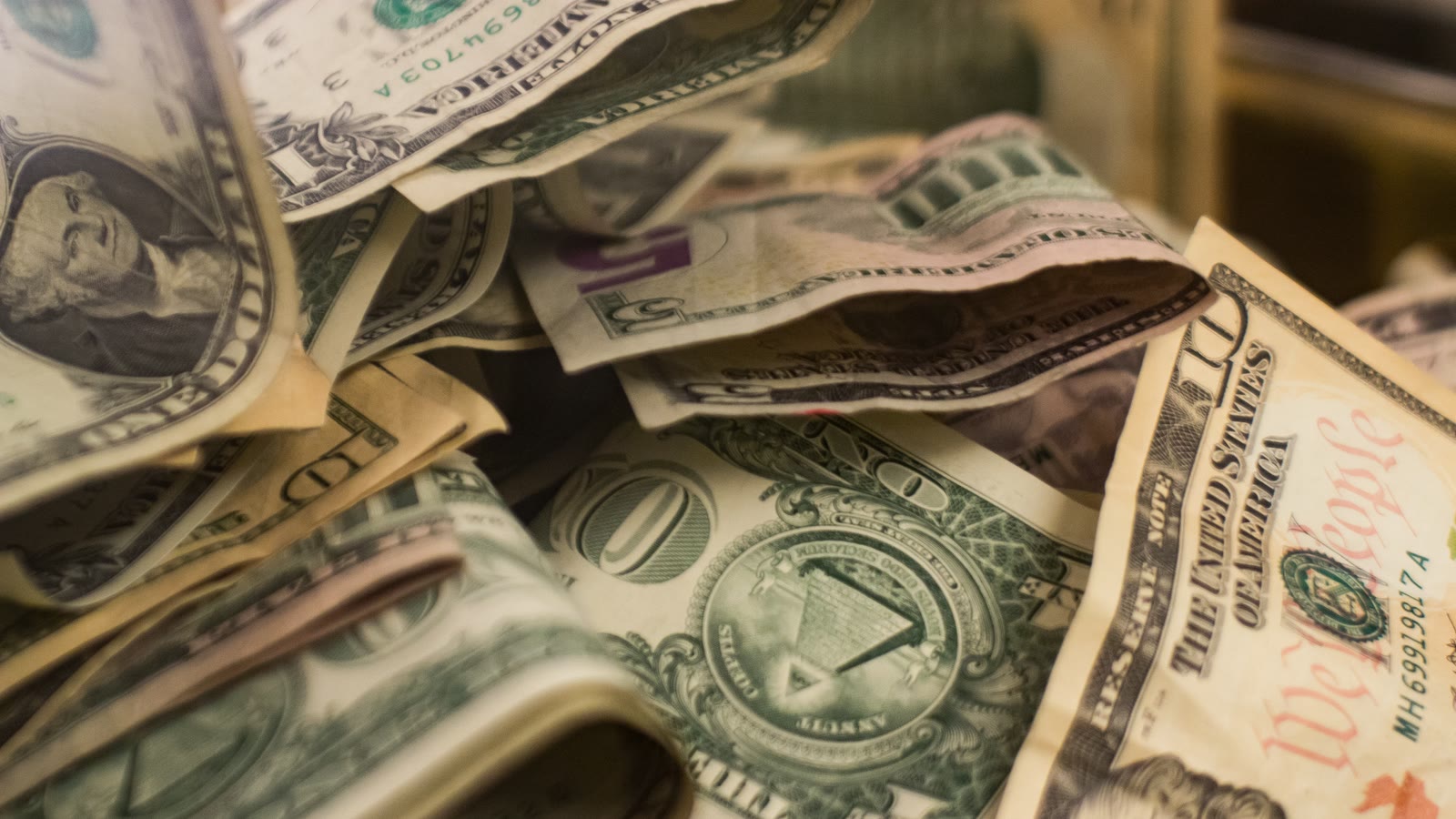
Denominations: the US issues notes of 1, 2, 5, 10, 20, 50 and 100 dollars. In everyday life, 1, 5, 10 and 20 dollar bills are the most practical; the 2 dollar bill is rarely seen. Smaller shops are reluctant to accept large notes. All bills are a similar green, so check the number when paying. Coins come in 1, 5, 10 and 25 cents. The US Mint stopped striking the 1-cent coin (penny) in November 2025. It remains legal tender, but some shops round cash payments to 5 cents.
Cash is still protected: several states and cities, including Massachusetts, New Jersey, New York City, Philadelphia and San Francisco, require most businesses to accept cash. Elsewhere, there are shops and stadiums that only accept cards.
ATMs: machines in or at bank branches are the safest. Cover the keypad when entering your PIN and watch out for devices attached to the card slot.
Reporting requirement: anyone entering or leaving the USA with more than USD 10,000 in cash or equivalent monetary instruments (e.g. traveler's checks) must report it to US Customs and Border Protection (CBP) on FinCEN Form 105. For families and travel groups, the combined total counts. Failure to report can lead to seizure. More on entry rules in our guide USA Entry: CBP and Customs.
Sales tax: why the price at the register is higher
Price tags in the USA almost always show the price before tax. Sales tax is added at the register. There is no nationwide sales tax; states, counties and cities set their own rates. According to the Tax Foundation's overview (as of July 1, 2026):
- No statewide sales tax: Alaska, Delaware, Montana, New Hampshire and Oregon. In Alaska, however, localities may levy their own taxes, and some Montana resort towns (for example near Yellowstone) charge a local resort tax.
- Highest state rate: California at 7.25 percent, plus local taxes.
- Highest combined average rates: Louisiana 10.13 percent, Tennessee 9.61 percent, Washington 9.57 percent.
- National average of state and local taxes combined: 7.53 percent.
An example: a jacket is priced at USD 120. With 9.5 percent tax, you pay USD 131.40 at the register. Each state decides which goods are taxed. In New York, for example, clothing and footwear under USD 110 per item are exempt from sales tax. Hotels usually add their own lodging taxes.
No tax refund as in Europe: unlike VAT in the EU, tourists in the USA generally get no refund of sales tax when leaving. Louisiana ended its refund program for international visitors on July 1, 2024. In Texas, a retailer can refund the tax only under strict conditions with proof of export. So build the tax firmly into your budget.
Card lost or stolen: what to do?
Act quickly so nobody can pay with your card:
- Block the card: call the German blocking hotline (Sperr-Notruf). From the USA, dial 011 49 116 116; from abroad in general, +49 116 116. The alternative number given by the Sperr-Notruf is +49 30 4050 4050. The line is available around the clock; calls from abroad may incur phone charges.
- Check your own bank: not all card issuers take part in the Sperr-Notruf. Before you travel, also note your bank's or card provider's own blocking number.
- Note the time: according to the EVZ, record the date and time of your blocking call.
- Report theft: in case of theft, file a report with the local police and get confirmation, for example for your bank or insurer.
- After returning: also have the card blocked via the police in Germany for the KUNO system. This is not possible from abroad.
So you are never left without a means of payment, keep two cards from different networks separately in your wallet and the hotel safe.
Payment methods compared
| Payment method | Shops and restaurants | Hotel/rental car deposit | ATM | Note |
|---|---|---|---|---|
| Credit card (Visa, Mastercard) | very good | yes, standard | yes, with PIN | check your credit limit |
| Debit card (Visa Debit, Debit Mastercard) | very good | often restricted | yes | amount is debited immediately |
| Girocard with Visa/Mastercard co-badge | good | often restricted | yes | works abroad via Visa/Mastercard |
| Girocard without co-badge | no | no | no | usable only in Germany |
| Prepaid credit card | good | usually not | depends on card | good as a second card |
| Apple Pay / Google Pay | very good | physical card needed | rarely | add a Visa/Mastercard card to the wallet |
| Cash (US dollars) | good | no | not applicable | for tips and small amounts |
Next steps
Plan to bring at least two cards from different networks, including a genuine credit card, and clarify fees and credit limits with your bank before you leave. Before paying comes entry: our Visa Check shows in a few minutes whether ESTA is enough or a visa is needed. We are happy to help with visa applications, Global Entry or individual questions; see all our services. This article provides non-binding guidance and is not financial or legal advice. Decisions on entry and stay rest solely with the US authorities.
Frequently asked questions
Does my German girocard work in the USA?+
A girocard without an additional function can only be used in Germany and does not work in the USA, not even digitally on your smartphone. If your girocard has a Visa Debit or Debit Mastercard co-badge, it works abroad via that network. Banks have hardly issued new girocards with Maestro since July 1, 2023; ask your bank which system your card uses.
Do I need a credit card for the USA?+
For everyday purchases a Visa or Mastercard debit card is often enough. For hotel deposits and especially rental cars, however, providers usually require a genuine credit card, for rental cars in the main driver's name. Debit and prepaid cards are often not accepted for this or only with restrictions.
Should I pay in euros or dollars in the USA?+
Always pay in US dollars. If a terminal or ATM offers to charge in euros, this is dynamic currency conversion (DCC) at a worse exchange rate. Your bank's conversion fee is usually cheaper.
Why does the gas pump in the USA ask for a ZIP code?+
Many pumps verify cards using the US postal code of the billing address. German cards have no ZIP code and are therefore often rejected. In that case, go to the cashier before filling up, state the pump number and amount or leave your card, or prepay in cash.
How much cash should I take to the USA?+
For the first few days, around USD 100 to 200 in small bills for tips and small purchases is usually enough; pay for the rest by card. US ATMs charge an average operator fee of USD 3.22. Anyone carrying more than USD 10,000 in cash into or out of the USA must report it on FinCEN Form 105.
Is sales tax included in the price, and can I get it back?+
No, prices in the USA are usually shown without sales tax, which is added at the register. Depending on location it ranges from 0 to just over 10 percent; Alaska, Delaware, Montana, New Hampshire and Oregon have no statewide sales tax. There is generally no refund for tourists like the EU VAT refund.
What should I do if I lose my card in the USA?+
Block the card immediately via the German Sperr-Notruf: from the USA 011 49 116 116, from abroad in general +49 116 116, alternative number +49 30 4050 4050. Not all banks take part, so also note your bank's own blocking number. In case of theft, file a report with the local police.
Sources
- Keine Maestro-Funktion mehr für Girokarten (Stand 26.08.2026) · Verbraucherzentrale Bundesverband
- Bezahlen im Ausland (aktualisiert 03.04.2026) · Europäisches Verbraucherzentrum Deutschland
- Mietwagen (aktualisiert 19.06.2026) · Europäisches Verbraucherzentrum Deutschland
- Tanken und Laden in den USA (Stand 30.10.2026) · ADAC
- State and Local Sales Tax Rates, Midyear 2026 · Tax Foundation
- Sperr-Notruf im Ausland: Was Reisende jetzt wissen sollten (17.06.2025) · Sperr-Notruf 116 116 e. V.
- Rule on Unfair or Deceptive Fees: Frequently Asked Questions · U.S. Federal Trade Commission
- ATM fees hit record high for third consecutive year (10.09.2025) · Bankrate
- Money and Other Monetary Instruments · U.S. Customs and Border Protection
Not sure what you need?
Find out in two minutes whether ESTA or a visa is right for you. We guide you personally through your visa application.
US-Visa-Service Redaktion
US entry & visa editorial team
Carefully researched and regularly reviewed. Non-binding guidance — the final decision on entry and visas rests solely with the US authorities.
Keep reading
Traveling to the USA for the First Time: Preparation & Everyday Life
A practical guide for your first trip to the USA: checklist, ESTA, travel health insurance, tipping, payments, eSIM, rental cars and everyday life – with up-to-date facts for 2026.
Read
US National Parks in the West: The Ultimate Road Trip Guide
Grand Canyon, Zion, Yellowstone, Yosemite and more: this guide covers the best routes, ideal travel seasons, the America the Beautiful annual pass, and everything you need to know before you go.
Read
Hawaii – Islands, Beaches & Volcanoes: Your Complete Travel Guide
Honolulu, Waikiki, the Road to Hana, active volcanoes, whale watching – Hawaii packs more wonder into one US state than almost anywhere else. Find out which island suits you, when to go, and what you need to know about entry requirements.
Read